I am an applied microeconomist and data scientist studying health, risky behavior, and public policy. My research examines how market access and public institutions shape substance use, treatment, and health outcomes. I also serve on Oregon’s Behavioral Health Resource Network Oversight and Accountability Council.

Pour Decisions: Alcohol Privatization and Birth Outcomes
Washington’s Initiative 1183 substantially expanded spirits access and household spirits purchasing. I study whether that aggregate market response translated into a detectable change in infant health and why the incidence of the behavioral response matters.
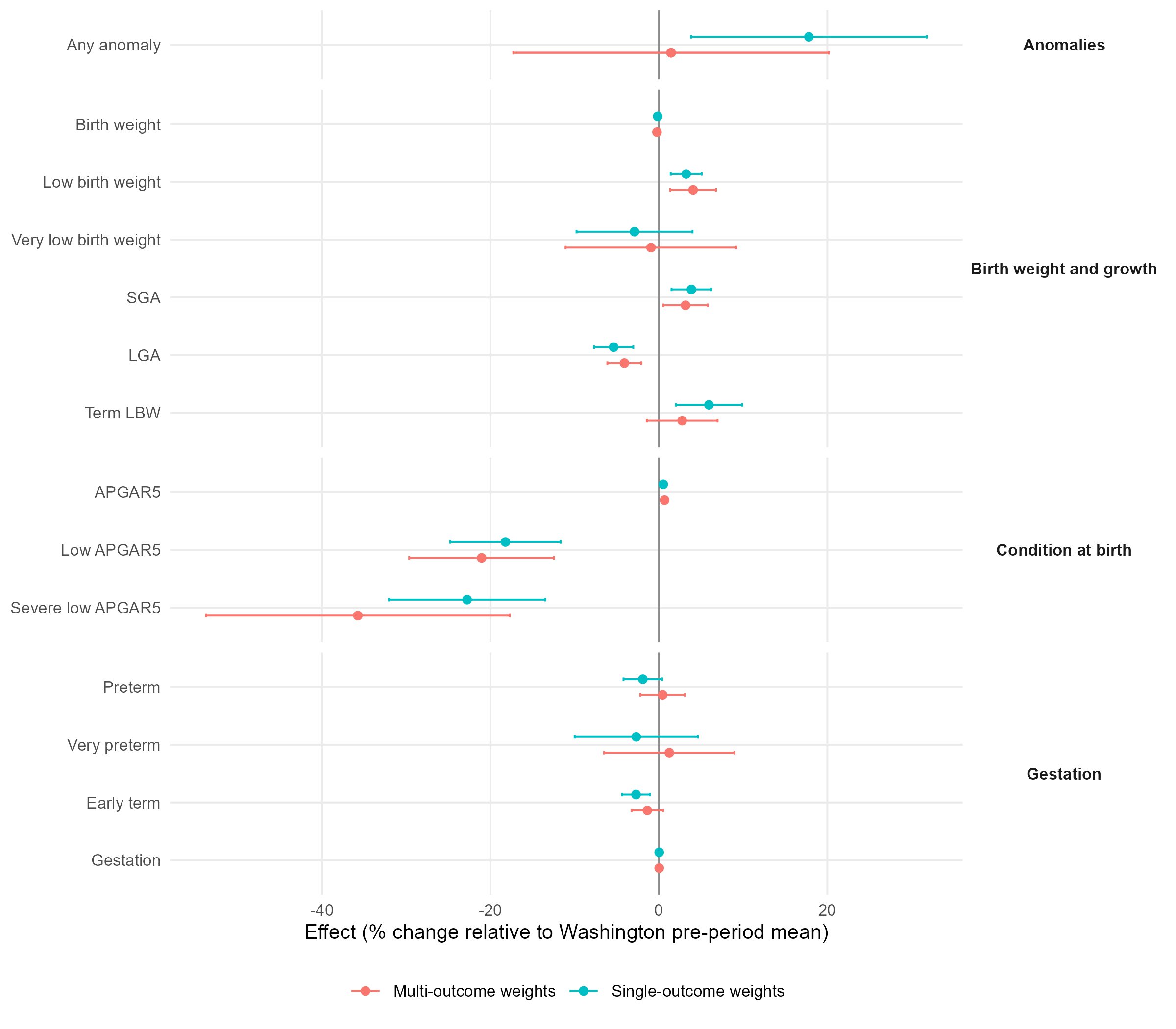
Abstract. Alcohol-market liberalization can change prices, retail availability, convenience, and product choice simultaneously. Increased alcohol use can generate substantial social and health costs, particularly when exposure occurs during pregnancy. Does a broad market reform that expands access to alcohol lead to poorer birth outcomes? I study Washington’s Initiative 1183, which privatized spirits retailing in June 2012 and expanded entry by grocery and big-box stores. I find that privatization substantially increased very local spirits access, bringing a larger share of the population within one mile of a spirits retailer. NielsenIQ Homescan data also show a 35% increase in recorded household spirits purchases after privatization. Substitution across beer, wine, and spirits, however, reduces the corresponding increase in total ethanol-equivalent purchasing to 9.2%, and the available household evidence suggests that much of the purchasing response occurred outside prime childbearing ages. Using restricted-use vital statistics and a repeated-cross-section synthetic difference-in-differences design, I find adverse point estimates for birth weight and fetal growth, but these estimates are not unusually large relative to fully refitted placebo-state estimates. I also find no large, coherent shift in the observed birth pool. The results show that the consequences of market liberalization depend not only on whether consumers respond, but on which dimensions of access change, substitution across products, and the incidence of the resulting behavioral response.
