Tracking TC Ownership: Service Type
The Rise in For-Profits: Why?
The last two posts of this series have outlined two descriptive facts among the substance use treatment center market.
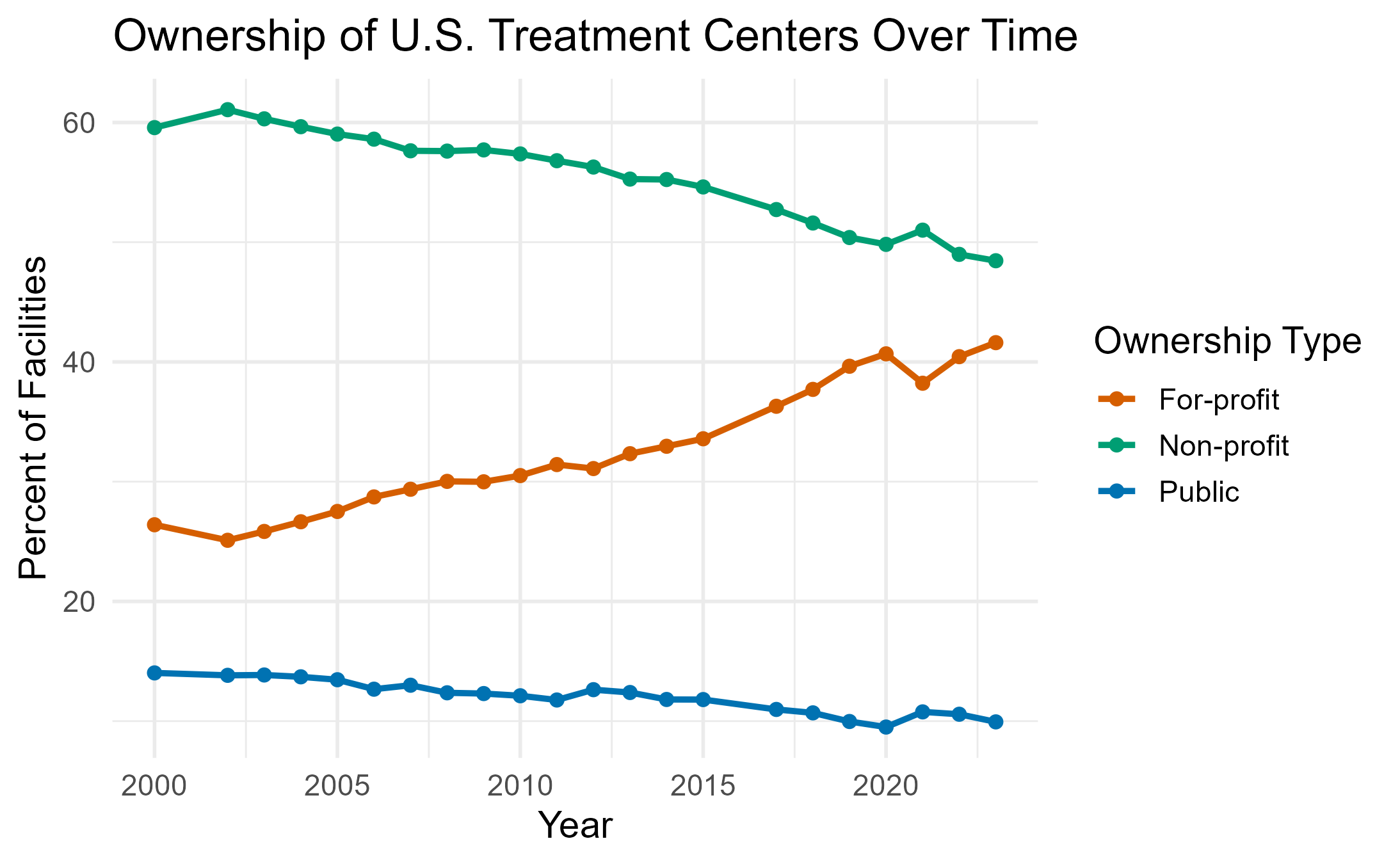
- In the first post, I showed that U.S. treatment centers have become increasingly centered on for-profit ownership. Using N-SSATS data, together with N-SUMHSS data subject to the documented comparability caveat, I showed that the for-profit share rose from roughly 25% in 2000 to more than 40%. While the share of public TCs over time has decreased, it seems to do so at a less drastic rate indicating that public TCs have not opened up over time. By contrast, the for-profit and nonprofit shares move largely in opposite directions. This pattern is less apparent among mental health facilities and hospitals, suggesting that it may be specific to substance use treatment.
- One of my initial thoughts was that the payment accepted by these for-profit treatment centers may be different than that of the non-profit TCs. The charts show similar responsiveness to the acceptance of different payment types across time, which is in line with much of the health economic literature. We see that, regardless of ownership, firms respond similarly to each other. One of the more notable gaps was in the acceptance of public insurance.

Today, I explore differences in the care settings of treatment centers across time. The motivation behind this is twofold. Because for-profit facilities maximize profit while nonprofit facilities may place additional weight on quality, ownership patterns may differ across care settings if quality also differs across settings. For instance, if outpatient TCs provide lower-quality care than residential centers, we may see non-profits move towards that. I mention quality because many of the models of non-profit hospitals use quality as another part of the objective function; I discussed the Newhouse model specifically in this post. We can think of this lens as more of an entry-exit decision by TCs.
The other motivation is a substitution decision. This has been briefly studied in the hospital literature, but theoretical models do not tend to match up well with substitution behavior. What I mean by substitution behavior is a firm entering as one ownership type and changing over time. Cutler and Horwitz’s chapter in the Handbook of Health Economics provides one example. Sloan also devotes a section of his handbook chapter and several papers to the question.
That being said, and as Sloan notes, understanding why a firm switches — and better yet, the marginal social value of switching — is “far from a trivial task.” So today, I only hope to show some descriptives that might indicate that we are seeing switching behavior in the TC market and reflect on possible mechanisms.
TC Switching?
I use data from the N-SSATS (2000-2020) and the N-SUMHSS (after 2020). The original purpose of this exercise was to determine whether for-profit TCs gravitate toward particular services. Because care setting and service mix are closely related, ownership shares by setting provide a useful first descriptive comparison. I found the same broad pattern as in the full TC sample: for-profit ownership rose across all care settings.


What I assumed I would find was that for-profit centers tended to offer residential services. I expected these high-revenue specialty services to attract for-profit providers. I was thinking of the almost spa-like retreat centers celebrities go to. Instead, I found that most residential treatment centers are non-profits, and that the ownership share for for-profits was highest among inpatient and outpatient centers.
In retrospect, since residential facilities involve such long stays, patients might want to ensure they have a quality stay. Because treatment quality is difficult for patients to observe in advance, nonprofits may have a comparative advantage in residential treatment. I also imagine that residential treatment programs are high-cost since they offer round-the-clock care and wraparound services. These operating costs may also limit the revenue potential for a for-profit center. Furthermore, an entity planning to open a residential center may prefer to open as a non-profit due to the property tax incentives of the non-profit. If they provide enough charity care, they receive both income and often property tax exemption. We might also expect variation across states because eligibility requirements for nonprofit property-tax exemptions can differ from federal nonprofit status and depend on how property is used.

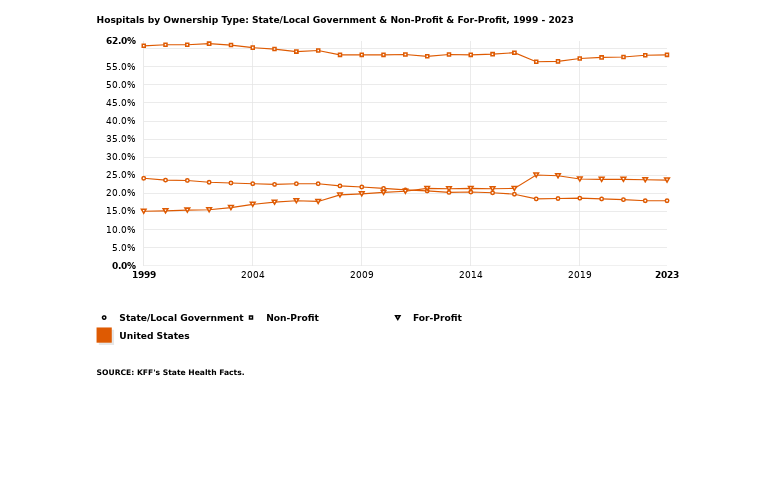
Inpatient shares being higher for for-profits in the long run makes sense with the slight rise in for-profit hospital ownership. The two series move together closely.
The clearest pattern, however, is the rise in for-profit ownership among outpatient centers. Outpatient centers do not provide round-the-clock care and generally require less physical space, making them less costly to operate. Medication-based outpatient services may also offer more predictable reimbursement. In fact, I am most surprised that the rise was only recent. One hypothesis worth testing is whether some pre-2011 for-profit outpatient facilities relied heavily on OxyContin prescribing and subsequently changed their service mix after the 2011 reformulation. The residential and inpatient shares appear to follow a different path after that change, although ACA implementation and other contemporaneous policies offer competing explanations.
Final Thoughts
The inverse relationship between for-profit and nonprofit shares across care settings suggests a useful empirical question: do these changes reflect ownership conversions within facilities, or differential entry and exit? The current figures cannot distinguish those mechanisms because they describe aggregate ownership shares rather than facility-level transitions.
At the time of writing, I was preparing to teach EC 320 and develop replication exercises for the course. The next step for this series is to harmonize the N-SSATS files across years. The existing concatenated file for 1997-2011 remains difficult to clean, and a more consistent longitudinal build would make it possible to study facility-level transitions directly.
